About Me

My photo
Emmaus, Pennsylvania, United States
My name is Rob and I'm fairly scatter-brained. I have no children and never plan on being a father, so this blog (that I've had since high school) will serve as my legacy. It's for information about me but also serves as an outlet to (somewhat) organize my thoughts. I enjoy hiking, reading/writing at cafés, travel, doing social things although I'm introverted, trying stand-up comedy, museums, litter pick-ups, volunteer work...

Monday, March 23, 2020

Facts About United States

Facts About United States

Which U.S. state’s name was completely made up?

Charleston is the capital city of which state? (Hint: not South Carolina)

Where might you spend a year in jail for cutting down a certain plant?

All these answers and more can be found below.

Please note:
*Some nicknames and mottos are not official but commonly used.
*The letters in parentheses are postal abbreviations.
*‘Etymology’ means ‘where the state’s name comes from’.
*Some of the weird laws possibly no longer exist (if they ever did) but I tried to pick ones with several sources.


Before learning about the individual states, the country as a whole is called the United States of America. The ‘United States’ part is simple enough but what about ‘America’?

Italian explorer Amerigo Vespucci visited the region in 1501 and was the first to (accurately) suggest that Christopher Columbus did not land in India but on a “new” continent.

To honor him, a map from 1507 names this place America, which is the Romanticized (Latin-ized) version of Amerigo.

Please note that two continents are named for Vespucci, not just one country.

And now, the states…

ALABAMA (AL)

The Cotton State
22nd state, admitted in 1819

ETYMOLOGY
Creek and/or Choctaw terms meaning ‘tribal town’ or ‘vegetation gatherers’

CAPITAL
Montgomery

OTHER NOTABLE CITIES
Birmingham (Civil Rights Institute)
Huntsville (Space & Rocket Center)
Tuscaloosa (University of Alabama Crimson Tide)

WEIRD LAW
Confetti is illegal in Mobile, which held the first American Mardi Gras festival in 1703.

STATE MOTTO
“Audemus jura nostra defendere”
(Latin for “We dare to defend our rights”)


ALASKA (AK)

The Last Frontier
49th state, admitted in 1959

ETYMOLOGY
The Aleut word ‘Alyeska’ means ‘The Great Land’

CAPITAL
Juneau

OTHER NOTABLE CITIES
Anchorage (Chugach State Park)
Nome (end of Iditarod sled dog race)
Utqiagvik (formerly called Barrow; northernmost U.S. city)

WEIRD LAW
Animals- specifically flamingoes- are not allowed in barber shops and places where food is sold.

STATE MOTTO
“North to the future”


ARIZONA (AZ)

The Grand Canyon State
48th state, admitted in 1912

ETYMOLOGY
Native American words meaning ‘silver-bearing’ and/or ‘the land of the small spring’

CAPITAL
Phoenix

OTHER NOTABLE CITIES
Flagstaff (Lowell Observatory)
Tucson (Saguaro National Park)
Yuma (Yuma Territorial Prison)

WEIRD LAW
Cutting down a saguaro cactus could get you a year in jail. The species is endangered and grows very slowly, sometimes taking 100 years or more to sprout an arm.

STATE MOTTO
“Ditat deus”
(Latin for “God enriches”)


ARKANSAS (AR)

The Natural State
25th state, admitted in 1836

ETYMOLOGY
Early French explorers heard the Algonquian word ‘Arkansas’ referring to a ‘people who live downstream’. The origin of the pronunciation is disputed but one theory says explorer Zebulon Pike spelled it Arkansaw.

CAPITAL
Little Rock

OTHER NOTABLE CITIES
Fayetteville (Ozark Mountains)
Hot Springs (Hot Springs National Park)
Eureka Springs (Thorncrown Chapel)

WEIRD LAW
Though it must certainly happen, flirting in public in Little Rock is illegal.

STATE MOTTO
“Regnat populus
 (Latin for “The people rule”)


CALIFORNIA (CA)

The Golden State
31st state, admitted in 1850

ETYMOLOGY
A common hypothesis points to a fictional place in the 1510 novel ‘Las sergas de Esplandián’, which is Spanish for ‘The Adventures Of Esplandián’

CAPITAL
Sacramento

OTHER NOTABLE CITIES
Los Angeles (Hollywood)
San Francisco (Alcatraz)
San Diego (Balboa Park)

WEIRD LAW
Riding a bicycle in a public swimming pool is illegal.

STATE MOTTO
“Eureka!”
(Greek for “I found it!”)


COLORADO (CO)

The Centennial State
38th state, admitted in 1876

ETYMOLOGY
‘Colored red’ in Spanish. The state was named for the Colorado River, which runs along red sandstone.

CAPITAL
Denver

OTHER NOTABLE CITIES
Boulder (Flatirons)
Colorado Springs (Garden of the Gods)
Aspen (Rocky Mountain skiing)

WEIRD LAW
Lending a vacuum cleaner to your neighbor is prohibited in Denver.

STATE MOTTO
“Nil sine numine”
(Latin for “Nothing without providence”)


CONNECTICUT (CT)

The Constitution State
5th state, admitted in 1788

ETYMOLOGY
The Algonquian word ‘Quinnehtukqut’ means ‘land beside the long tidal river’

CAPITAL
Hartford

OTHER NOTABLE CITIES
Bridgeport (PT Barnum Museum)
New Haven (Yale University)
Stamford (World Wrestling Entertainment)

WEIRD LAW
In several towns, walking backwards after sunset is prohibited.

STATE MOTTO
“Qui transtulit sustinet”
(Latin for “He who transplanted still sustains”)


DELAWARE (DE)

The First State
1st state, admitted in 1787

ETYMOLOGY
The first governor of Jamestown (England’s first settlement in North America) was Thomas West, also known as Lord De La Warr. The origin of that moniker is unknown but may have ties to the French military.

CAPITAL
Dover

OTHER NOTABLE CITIES
Wilmington (Grand Opera House)
Rehoboth Beach (boardwalk)
Milton (Dogfish Head Brewery)

WEIRD LAW
You may not change clothes in a car or public restroom.

STATE MOTTO
“Liberty and independence”


FLORIDA (FL)

The Sunshine State
27th state, admitted in 1845

ETYMOLOGY
Original name was ‘Pascua Florida’, which means ‘flowery Easter’ in Spanish. Spain discovered the region during the Easter period.

CAPITAL
Tallahassee

OTHER NOTABLE CITIES
Jacksonville (Catty Shack Ranch Wildlife Sanctuary)
Orlando (Disney World)
Cape Canaveral (Kennedy Space Center)

WEIRD LAW
No singing in public while wearing a swimsuit.

STATE MOTTO
“In God we trust”


GEORGIA (GA)

The Peach State
4th state, admitted in 1788

ETYMOLOGY
King George II, who ruled Great Britain from 1727 to 1760

CAPITAL
Atlanta

OTHER NOTABLE CITIES
Savannah (haunted houses and tours)
Augusta (PGA golf tournament)
Athens (hometown of R.E.M.)

WEIRD LAW
Giraffes may not be tied to telephone poles or street lamps.

STATE MOTTO
“Wisdom, justice, moderation”


HAWAI’I (HI)

The Aloha State
50th state, admitted in 1959

ETYMOLOGY
The exact origin is unclear but the name is from the Hawai’ian/Polynesian language group and possibly means ‘homeland’, ‘land of the gods’, and/or is a reference to a mythological figure

CAPITAL
Honolulu

OTHER NOTABLE CITIES
Hilo (Volcanoes National Park)
Waialua (setting for ‘Lost’ and other shows/movies)
Lahaina (whale watching)

WEIRD LAW
Appearing anywhere in public other than a beach wearing only a swimsuit is technically illegal.

STATE MOTTO
“Ua mau ke ea o ka ʻāina i ka pono”
(Hawai’ian for “The life of the land is perpetuated in righteousness.”)


IDAHO (ID)

The Gem State
43rd state, admitted in 1890

ETYMOLOGY
The area was named by political lobbyist George Willing, supposedly from a Shoshone phrase meaning ‘gem of the mountains’. By the time it was discovered that Willing made the whole thing up, ‘Idaho’ was being widely used.

CAPITAL
Boise

OTHER NOTABLE CITIES
Couer d’Alene (lake town in panhandle)
Idaho Falls (Collector Corner Museum)
Twin Falls (Shoshone Waterfall)

WEIRD LAW
Though enacted as a goof and never enforced, a law requires people to smile while walking around the town of Pocatello.

STATE MOTTO
“Esto perpetua”
(Latin for “Let it be perpetual”)


ILLINOIS (IL)

The Prairie State / Land Of Lincoln
21st state, admitted in 1818

ETYMOLOGY
French version of the Peoria word meaning ‘tribe of superior men’. Oddly, the name does not originate from the language of the Illinois tribe.

CAPITAL
Springfield

OTHER NOTABLE CITIES
Chicago (Millennium Park)
Aurora (Wayne’s World)
Rockford (Peaches of the All-American Girls Professional Baseball League)

WEIRD LAW
Mispronounce the town of Joliet (Joe-lee-ett) and receive a $5 fine.

STATE MOTTO
“State sovereignty, national unity”


INDIANA (IN)

The Hoosier State
19th state, admitted in 1816

ETYMOLOGY
An Anglicized (European-ized) word meaning ‘land of the Indians’, since Christopher Columbus mistakenly thought he landed in India

CAPITAL
Indianapolis

OTHER NOTABLE CITIES
Fort Wayne (Johnny Appleseed Park)
Gary (Michael Jackson’s hometown)
South Bend (University of Notre Dame)

WEIRD LAW
Taking a bath between October and March is illegal.

STATE MOTTO
“The crossroads of America”


IOWA (IA)

The Hawkeye State
29th state, admitted in 1846

ETYMOLOGY
The Ioway people formed a branch of the Sioux tribe

CAPITAL
Des Moines (French for ‘The Monks’)

OTHER NOTABLE CITIES
Sioux City (Lewis & Clark Interpretive Center)
Dubuque (Mississippi River Museum)
Dyersville (Field Of Dreams filming location)

WEIRD LAW
Before you throw bricks and missiles onto public streets, get permission from the Town Council.

STATE MOTTO
“Our liberties we prize and our rights we will maintain”


KANSAS (KS)

The Sunflower State
34th state, admitted in 1861

ETYMOLOGY
‘People of the wind’ in several local tribal languages, including Kanza

CAPITAL
Topeka

OTHER NOTABLE CITIES
Wichita (Botanica: The Wichita Gardens)
Dodge City (get out of Dodge)
Kansas City (Kansas Speedway)

Note: Kansas City, Missouri, was named for the Kansas River eight years before Kansas became a state. Kansas City, Kansas, was named after the Missouri city, hoping to capitalize on its success. The two are separate cities but are included together in the Kansas City Metro Area.

WEIRD LAW
Do not throw a knife at anyone wearing stripes.

STATE MOTTO
“Ad astra per aspera”
(Latin for “To the stars through difficulties”)


KENTUCKY (KY)

The Bluegrass State
15th state, admitted in 1792

ETYMOLOGY
From a Wyandot (branch of Iroquois) term meaning ‘land of tomorrow’ or referring to a meadow or field

CAPITAL
Frankfort

OTHER NOTABLE CITIES
Louisville (Louisville Slugger Museum & Factory)
Clermont (Jim Beam American Stillhouse)
Cave City (Mammoth Cave National Park)

WEIRD LAW
According to statute 436.600, it is unlawful to dye fowl or rabbits any color unless you are selling six or more of them. Less than that amount is animal cruelty.

STATE MOTTO
“United we stand, divided we fall”


LOUISIANA (LA)

The Pelican State
18th state, admitted in 1812

ETYMOLOGY
Named for the French King Louis XIV, the territory known as Louisiana was sold to the U.S. by Napoleon Bonaparte in 1803 and divided into all or part of 15 separate states

CAPITAL
Baton Rouge (French for ‘red stick’)

OTHER NOTABLE CITIES
New Orleans (Bourbon Street)
Lafayette (Vermilionville living history museum)
Shreveport (Sci-Port Discovery Center)

WEIRD LAW
Television reporters are not allowed to throw candy during parades in New Orleans.

STATE MOTTO
“Union, justice, confidence”


MAINE (ME)

The Pine Tree State
23rd state, admitted in 1820

ETYMOLOGY
Thought to have been called the ‘main’ land to distinguish it from nearby islands. Many older English words had an ‘e’ at the end.

CAPITAL
Augusta

OTHER NOTABLE CITIES
Portland (Old Port district)
Bangor (Stephen King’s house)
Bar Harbor (Acadia National Park)

WEIRD LAW
In Waterville, best to let snot drip from your face since blowing your nose in public is forbidden.

STATE MOTTO
“Dirigo”
(Latin for “I lead”)


MARYLAND (MD)

The Old Line State
7th state, admitted in 1788

ETYMOLOGY
Queen Henrietta Maria, wife of King Charles I of England

CAPITAL
Annapolis

OTHER NOTABLE CITIES
Baltimore (Fort McHenry)
Frederick (Museum of Civil War Medicine)
Ocean City (beaches)

WEIRD LAW
In Baltimore, you may not take a lion to a movie theater.

STATE MOTTO
“Fatti maschi, parole femine”
(Italian for “Strong deeds, gentle words”; formerly translated as “Manly deeds, womanly words”)


MASSACHUSETTS (MA)

The Bay State
6th state, admitted in 1788

ETYMOLOGY
Algonquian term thought to reference a ‘great hill’

CAPITAL
Boston

OTHER NOTABLE CITIES
Worcester (EcoTarium)
Salem (1692 witch trials)
Springfield (Basketball Hall Of Fame)

WEIRD LAW
While mourning at a wake, eating more than three sandwiches is not permitted.

STATE MOTTO
“Ense petit placidam sub libertate quietem”
(Latin for “By the sword we seek peace, but peace only under liberty”)
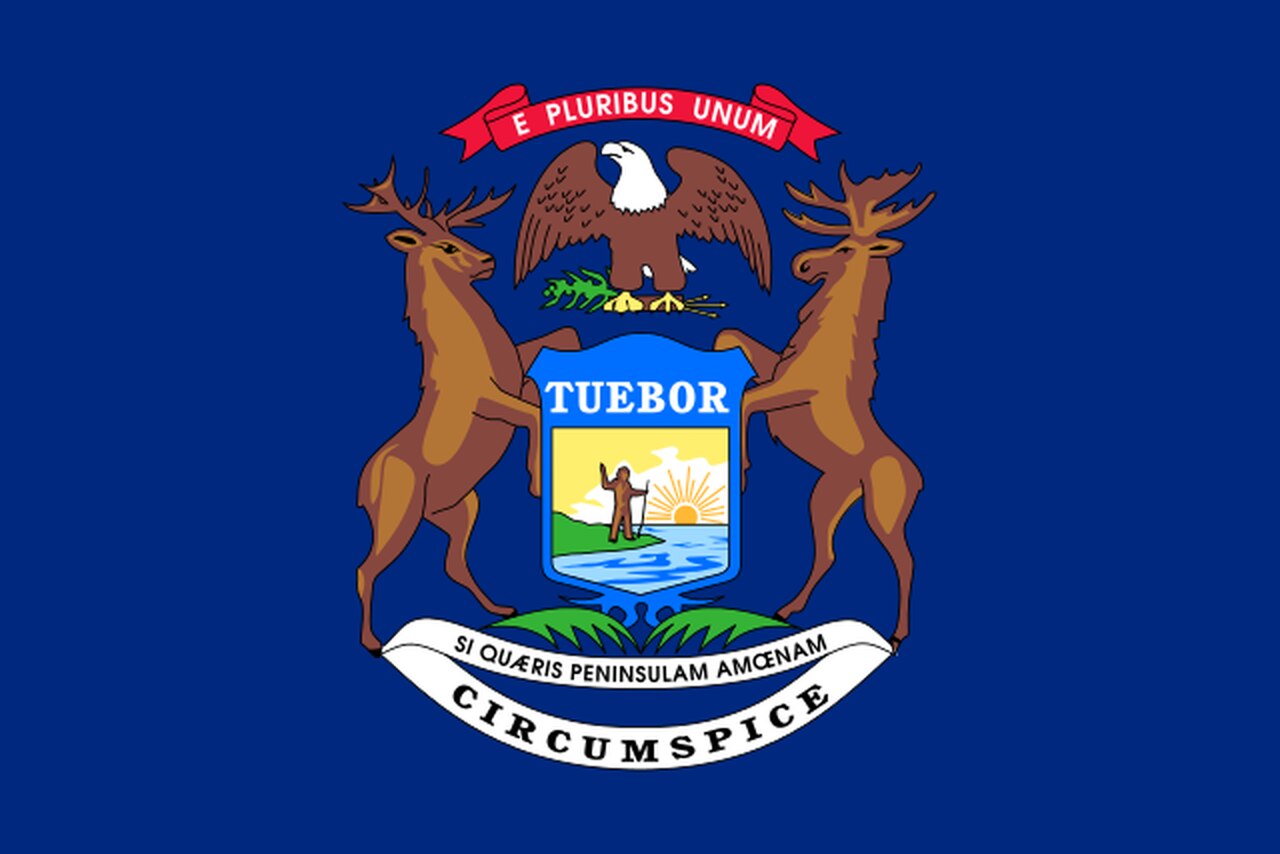

MICHIGAN (MI)

The Great Lakes State
26th state, admitted in 1837

ETYMOLOGY
Chippewa word meaning ‘great water’, probably used to describe Lake Superior

CAPITAL
Lansing

OTHER NOTABLE CITIES
Detroit (Motown Museum)
Grand Rapids (Frederik Meijer Gardens & Sculpture Park)
Dearborn (Henry Ford Museum)

WEIRD LAW
Painting a sparrow to look like a parakeet is illegal.

STATE MOTTO
“Si quaeris peninsulam amoenam circumspice”
(Latin for “If you seek a pleasant peninsula, look about you”)


MINNESOTA (MN)

The North Star State
32nd state, admitted in 1858

ETYMOLOGY
Sioux word meaning ‘cloudy water’, possibly referencing some of Minnesota’s “10,000 lakes”, though it really has almost 12,000

CAPITAL
Saint Paul

OTHER NOTABLE CITIES
Minneapolis (Mall Of America)
Duluth (Aerial Lift Bridge)
Rochester (Mayo Clinic)

WEIRD LAW
Women impersonating Santa Claus could face 30 days in jail.

STATE MOTTO
“L'étoile du Nord”
(French for “The star of the North”)


MISSISSIPPI (MS)

The Magnolia State
20th state, admitted in 1817

ETYMOLOGY
English version of a French version of a Native American word meaning ‘great river’

CAPITAL
Jackson

OTHER NOTABLE CITIES
Biloxi (Beauvoir – Jefferson Davis’s house)
Gulfport (Model Railroad Museum)
Hattiesburg (Armed Forces Museum)

WEIRD LAW
Practicing polygamy is forbidden and teaching it can get a person fined and/or months in jail.

STATE MOTTO
“Virtute et armis”
(Latin for “By valor and arms”)


MISSOURI (MO)

The Show-Me State
24th state, admitted in 1821

ETYMOLOGY
Disputed but comes from a Native American word somehow relating to canoes

CAPITAL
Jefferson City

OTHER NOTABLE CITIES
Kansas City (barbecue)
Saint Louis (Budweiser)
Branson (Titanic Museum)

Note: Kansas City, MO, was named for the Kansas River eight years before Kansas became a state. Kansas City, Kansas, was named after the Missouri city, hoping to capitalize on its success. The two are separate cities but are included together in the Kansas City Metro Area.

WEIRD LAW
Firefighters may not rescue women unless they are fully dressed.

STATE MOTTO
“Salus populi suprema lex esto”
(Latin for “Let the welfare of the people be the supreme law”)


MONTANA (MT)

The Treasure State
41st state, admitted in 1889

ETYMOLOGY
‘Montaña’ is the Spanish word for ‘mountain’

CAPITAL
Helena

OTHER NOTABLE CITIES
Billings (Yellowstone Art Museum)
Bozeman (Museum of the Rockies)
Missoula (Smokejumper Center)

WEIRD LAW
City employees in Billings may not use speed-dial while working.

STATE MOTTO
“Oro y plata”
(Spanish for “Gold and silver”)


NEBRASKA (NE)

The Cornhusker State
37th state, admitted in 1867

ETYMOLOGY
The Oto word ‘nebrathka’, meaning ‘flat water’ and probably referencing the Platte River

CAPITAL
Lincoln

OTHER NOTABLE CITIES
Omaha (Henry Doorly Zoo)
Bellevue (Volcanic Peppers store)
Ogallala (Petrified Wood Gallery)

WEIRD LAW
A possibly fake but definitely amusing law bans the hunting of whales, even though there are none in the state, not even at aquariums.

STATE MOTTO
“Equality before the law”


NEVADA (NV)

The Silver State
36th state, admitted in 1864

ETYMOLOGY
‘Snow-covered’ in Spanish, which is odd since the state is mostly desert, but the name probably refers to the Sierra Nevada mountains along its western border with California

CAPITAL
Carson City

OTHER NOTABLE CITIES
Las Vegas (casinos along the Strip)
Reno (National Automobile Museum)
Elko (Humboldt National Forest)

WEIRD LAW
When traveling a highway, you better be in a vehicle and not on a camel.

STATE MOTTO
“All for our country”


NEW HAMPSHIRE (NH)

The Granite State
9th state, admitted in 1788

ETYMOLOGY
A county in southern England

CAPITAL
Concord

OTHER NOTABLE CITIES
Manchester (Palace Theatre)
Portsmouth (Strawbery Banke Open-air Museum)
Sargent’s Purchase (Mount Washington)

WEIRD LAW
It is illegal to have a picnic in a cemetery.

STATE MOTTO
“Live free or die”


NEW JERSEY (NJ)

The Garden State
3rd state, admitted in 1787

ETYMOLOGY
The island of Jersey in the English Channel

CAPITAL
Trenton

OTHER NOTABLE CITIES
Newark (Prudential Center)
Jersey City (Liberty Science Center)
Asbury Park (beaches & boardwalk)

WEIRD LAW
Only state where it is illegal to pump your own gas. (Oregon has eased its restrictions, allowing self-service in certain areas.)

STATE MOTTO
“Liberty and prosperity”


NEW MEXICO (NM)

Land Of Enchantment
47th state, admitted in 1912

ETYMOLOGY
The state was established before the country of Mexico, which was also named for a large valley and/or an Aztec god. The Spanish called the region of the now-state Nuevo Mexico, which was changed to New Mexico in 1848 when the Spanish gave control of the territory to the U.S.

CAPITAL
Santa Fe, oldest (and highest-altitude) capital city in the United States.

OTHER NOTABLE CITIES
Albuquerque (Museum of Nuclear Science & History)
Roswell (aliens)
Taos (Enchanted Circle Drive)

WEIRD LAW
It is a misdemeanor to stop singing before the national or state anthem is complete.

STATE MOTTO
“Crescit eundo”
(Latin for “It grows as it goes”)


NEW YORK (NY)

The Empire State
11th state, admitted in 1788

ETYMOLOGY
Named to honor England’s Duke of York, who would later become King James II

CAPITAL
Albany

OTHER NOTABLE CITIES
New York City (Statue Of Liberty)
Buffalo (Buffalo wings)
Cooperstown (Baseball Hall Of Fame)

WEIRD LAW
If jumping off a building does not kill you, the punishment for doing so is death.

STATE MOTTO
“Excelsior”
(Latin for “Ever upward”)


NORTH CAROLINA (NC)

The Tar Heel State
12th state, admitted in 1789

ETYMOLOGY
King Charles I, who ruled England from 1625 until his execution for treason in 1649. He was married to Queen Henrietta Maria (see: Maryland). The Carolina Territory was split up peacefully for ease of governance.

CAPITAL
Raleigh

OTHER NOTABLE CITIES
Charlotte (NASCAR Hall Of Fame)
Asheville (beer scene)
Greensboro (1960 Woolworth sit-in)

WEIRD LAW
A gambling statute restricts the playing of Bingo to 10 hours per week.

STATE MOTTO
“Esse quam videri”
(Latin for “To be rather than to seem”)


NORTH DAKOTA (ND)

The Peace Garden State
39th state, admitted in 1889

ETYMOLOGY
‘Dakota’ is the Sioux word for ‘friend’. The Dakota Territory was split due to a dispute over the location of the capital city but may have also been politically motivated.

CAPITAL
Bismarck

OTHER NOTABLE CITIES
Fargo (famous for film and television show)
Minot (Scandinavian Heritage Park)
Medora (Theodore Roosevelt National Park)

WEIRD LAW
Falling asleep with shoes on is against the law.

STATE MOTTO
“Liberty and union, now and forever, one and inseparable”


OHIO (OH)

The Buckeye State
17th state, admitted in 1803

ETYMOLOGY
Iroquois word meaning ‘good river’

CAPITAL
Columbus

OTHER NOTABLE CITIES
Cleveland (Rock N Roll Hall Of Fame)
Cincinnati (American Sign Museum)
Canton (Pro Football Hall Of Fame)

WEIRD LAW
In Bexley, installing a slot machine in an outhouse is illegal.

STATE MOTTO
“With God, all things are possible”


OKLAHOMA (OK)

The Sooner State
46th state, admitted in 1907

ETYMOLOGY
‘Okla humma’, the Choctaw phrase meaning ‘red people’, though ‘humma’ may alternately mean ‘brave’ or ‘noble’

CAPITAL
Oklahoma City

OTHER NOTABLE CITIES
Tulsa (Center of the Universe)
Norman (National Weather Center)
Broken Arrow (Military History Museum)

WEIRD LAW
Considered a health hazard, biting someone else’s hamburger is not permitted.

STATE MOTTO
“Labor omnia vincit”
(Latin for “Work conquers all”)


(Only state with a two-sided flag.)

OREGON (OR)

The Beaver State
33rd state, admitted in 1859

ETYMOLOGY
Possibly a Native American or French Canadian word referencing the Columbia River

CAPITAL
Salem

OTHER NOTABLE CITIES
Portland (Japanese Garden)
Eugene (Cascades Raptor Center)
Bend (Tumalo waterfall)

WEIRD LAW
Juggling in Hood River without a license is a crime.

STATE MOTTO
“Alis volat propriis”
(Latin for “She flies with her own wings”)


PENNSYLVANIA (PA)

The Keystone State
2nd state, admitted in 1787

ETYMOLOGY
William Penn, the peaceful Quaker who founded the colony, and the Latin word ‘silvania’, meaning ‘woodland’ (which, by itself, was Penn’s initial suggestion)

CAPITAL
Harrisburg

OTHER NOTABLE CITIES
Philadelphia (Independence Hall)
Pittsburgh (Senator John Heinz History Center)
Hershey (chocolate)

WEIRD LAW
Fishing is legal but using dynamite to catch them is not.

STATE MOTTO
“Virtue, liberty, and independence”

RHODE ISLAND (RI)

The Ocean State
13th state, admitted in 1790

ETYMOLOGY
When discovered, the explorers thought the area was an island containing red clay, similar to the Greek island of Rhodes

CAPITAL
Providence

OTHER NOTABLE CITIES
Newport (mansions)
Narragansett (beaches)
Cranston (Pawtuxet Village)

WEIRD LAW
You may not marry someone who is certifiably insane.

STATE MOTTO
“Hope”


SOUTH CAROLINA (SC)

The Palmetto State
8th state, admitted in 1788

ETYMOLOGY
King Charles I, who ruled England from 1625 until his execution for treason in 1649. He was married to Queen Henrietta Maria (see: Maryland). The Carolina Territory was split up peacefully for ease of governance.

CAPITAL
Columbia

OTHER NOTABLE CITIES
Charleston (Fort Sumter National Monument)
Hilton Head Island (golf tournament)
Rock Hill (Fire Station Museum)

WEIRD LAW
Minors (people under 18) may not play Pinball.

STATE MOTTO
“Dum spiro spero”
(Latin for “While I breathe, I hope”)


SOUTH DAKOTA (SD)

The Mount Rushmore State
40th state, admitted in 1889

ETYMOLOGY
‘Dakota’ is the Sioux word for ‘friend’. The Dakota Territory was split due to a dispute over the location of the capital city but may have also been politically motivated.

CAPITAL
Pierre

OTHER NOTABLE CITIES
Sioux Falls (Falls Park)
Mitchell (The Corn Palace)
Deadwood (‘Wild Bill’ & ‘Calamity Jane’ gravesites)

WEIRD LAW
Challenging a pacifist to an arm-wrestling contest is illegal.

STATE MOTTO
“Under God, the people rule”


TENNESSEE (TN)

The Volunteer State
16th state, admitted in 1796

ETYMOLOGY
Tanasi was a Cherokee town, but the source of the name is not known

CAPITAL
Nashville

OTHER NOTABLE CITIES
Memphis (Graceland)
Lynchburg (Jack Daniels distillery)
Knoxville (World’s Fair Park)

WEIRD LAW
In Memphis, panhandling is a misdemeanor unless a $10 permit is obtained first.

STATE MOTTO
“Agriculture and commerce”


TEXAS (TX)

The Lone Star State
28th state, admitted in 1845

ETYMOLOGY
Caddo word meaning ‘friends’

CAPITAL
Austin

OTHER NOTABLE CITIES
Houston (NASA Space Center – “Houston, we have a problem.”)
Dallas (Reunion Tower)
San Antonio (The Alamo)

WEIRD LAW
An unfortunately un-passed bill would have required criminals to provide 24-hour notice of their crimes to victims.

STATE MOTTO
“Friendship”


UTAH (UT)

The Beehive State
45th state, admitted in 1896

ETYMOLOGY
Either a Ute word meaning ‘people of the mountains’ or an Apache word meaning ‘those that are higher up’

CAPITAL
Salt Lake City

OTHER NOTABLE CITIES
Provo (The Soap Factory)
Ogden (George S. Eccles Dinosaur Park)
Moab (Arches National Park)

WEIRD LAW
In Provo, where the average annual snowfall is 43 inches, a $50 fine may be assessed to anybody throwing a snowball.

STATE MOTTO
“Industry”


VERMONT (VT)

The Green Mountain State
14th state, admitted in 1791

ETYMOLOGY
‘Vert mont’ means ‘green mountain’ in French

CAPITAL
Montpelier

OTHER NOTABLE CITIES
Burlington (Lake Champlain)
Stowe (von Trapp Family Lodge)
Waterbury (Ben & Jerry’s Factory)

WEIRD LAW
Still on the books is an 1856 law demanding women get permission from their husbands before obtaining false teeth.

STATE MOTTO
“Freedom and unity”


VIRGINIA (VA)

The Old Dominion
10th state, admitted in 1788

ETYMOLOGY
Queen Elizabeth I (a.k.a. the Virgin Queen), who ruled England from 1558 to 1603

CAPITAL
Richmond

OTHER NOTABLE CITIES
Virginia Beach (boardwalk and beaches)
Charlottesville (Monticello – Thomas Jefferson’s house)
Williamsburg (colonial village)

WEIRD LAW
Flipping a coin in a Richmond restaurant to decide who pays is not allowed.

STATE MOTTO
“Sic semper tyrannis”
(Latin for “Thus always to tyrants”)


WASHINGTON (WA)

The Evergreen State
42nd state, admitted in 1889

ETYMOLOGY
Honoring George Washington, first president of the United States

CAPITAL
Olympia

OTHER NOTABLE CITIES
Seattle (Space Needle)
Spokane (Manito Park)
Walla Walla (fun to say)

WEIRD LAW
An X-ray machine may not be used for fitting shoes.

STATE MOTTO
“Al-ki”
(Chinook for “By and by” or “Into the future”)


WEST VIRGINIA (WV)

The Mountain State
35th state, admitted in 1863

ETYMOLOGY
Queen Elizabeth I (a.k.a. the Virgin Queen), who ruled England from 1558 to 1603. This region of the territory known as Virginia seceded due to political differences, especially over the issue of slavery.

CAPITAL
Charleston

OTHER NOTABLE CITIES
Huntington (Museum of Radio & Technology)
Glen Jean (New River Gorge National Park)
Wheeling (Kruger Toy & Train Museum)

WEIRD LAW
To counter laws forbidding things, collecting and eating roadkill is legal in West Virginia. There is even an app-based system to find out where “fresh ones” are.

STATE MOTTO
“Montani semper liberi”
(Latin for “Mountaineers are always free”)


WISCONSIN (WI)

America’s Dairyland
30th state, admitted in 1848

ETYMOLOGY
English spelling of the French version of the Miami word ‘meskonsing’, referring to the red rocks along the Wisconsin River

CAPITAL
Madison

OTHER NOTABLE CITIES
Milwaukee (Pabst and Miller breweries)
Green Bay (Lambeau Field)
Eau Claire (Paul Bunyan Logging Camp)

WEIRD LAW
Dairy is taken very seriously and many bills to restrict substitute butter have been proposed.

STATE MOTTO
“Forward”


WYOMING (WY)

The Equality State
44th state, admitted in 1890

ETYMOLOGY
A word meaning ‘big river flat’, originally used by the Lenape for a region of Pennsylvania

CAPITAL
Cheyenne

OTHER NOTABLE CITIES
Jackson (Jackson Hole region)
Casper (Tate Geological Museum)
Laramie (Deer wood Ranch Wild Horse Sanctuary)

WEIRD LAW
Being drunk in a coal mine could get you a year in jail.

STATE MOTTO
“Equal rights”


Though it is not (yet) a state, our nation’s capital is also worth mentioning…

 WASHINGTON, D.C. (DC)

The Federal City
founded in 1790

ETYMOLOGY
The first part was named for George Washington.
D.C. stands for District Of Columbia, meaning a federal district within Columbia, an old (unofficial) name for the United States, representing Christopher Columbus.

NOTABLE SITES
Smithsonian Museums (Air & Space, African American History, Natural History)
National Mall including Lincoln Memorial & Washington Monument
Memorials (Vietnam Veterans, World War 2, Grant’s Tomb)

WEIRD LAW
People have been arrested for dancing inside the Jefferson Memorial.

MOTTO
“Justitia omnibus”
(Latin for “Justice for all”)


If all this did not satisfy your hunger for U.S. state information, go [here] to find out official state things and other such tidbits.

Please report any errors in the comments section at the bottom of this page.

Thanks for reading!


SOURCES:
Google.com, Britannica.com, AL.comState Symbols USA, BabbelArkansas.govjetpunk.comUtah.govThe Daily Mealweirdfacts.com, stupidlaws.com, onlyinyourstate.complanetware.com, kchistory.org, tripadvisor.com

The Dreaded Door Dilemma

The Dreaded Door Dilemma


Here’s the scene:

I walk up to a store, pull the door open, and slide into the building.

For some reason, I glance behind me to see some guy walking toward the entrance, about 30 feet away.

My goal was to enter the store, which I’ve done. Time to move on to Phase 2, right? Time to buy pants and a flashlight, right!?

Maybe not.

Obligation overwhelms me.

But why should I hold the door open for this guy? I saw him get out of a car so he was clearly able to drive himself here. He’s walking upright and both of his (empty) arms seem to function just fine. The door isn't heavy. Surely, he’s capable of opening it for himself.

I thought too long about it so here I am, half in a store's foyer, holding a door open with my body bent in some strange way.

And now this door is feeling weighty. I still have time to let it go and walk in.

What’s the worst that would reasonably happen?

A stranger thinks I’m rude. Even if he says something, I can pretend I'm sorry and be done with it.

But no, I'll hold it for him because that's what's "supposed to" be done.

And what happens when he finally reaches the door? He turns left. No acknowledgement. No appreciation. No result from my unnecessary struggle. This time was truly wasted.

What’s the solution? Is there proper etiquette for this common situation?

Normally, I’d say flinging the door open and walking in like royalty without further touching said door would be the answer. This way you were never holding the door, even for yourself. And if you don’t look back, how could you know someone was there?

But of course you know when someone is there.

Here are some proposed actions to be taken, which are directly based on the person’s distance to the door:

If the person is more than 35 feet from you, absolutely do not consider holding the door. Use your eyes to judge and give or take fifteen feet, but only take it. You owe this person nothing.

And maybe you have a nice butt, so the individual should be grateful for the opportunity to see it in action.

That's simple enough, but what if the person is…

…disabled, physically or mentally?

Hold the door and step to the side, allowing them to pass. Not doing so could make strangers think you’re awful, which is usually fine, but that breed of awful is unacceptable.

…obscenely ancient and near-blind?

Do the same because they might think you work for the store and give you a wrinkled dollar bill.

…a mom with children?

Immediately walk in like royalty and let the door close behind you. Don’t help her kids; they need to learn for themselves. Odds are they will be unruly, so Mom won’t have time to scold you when she doesn’t understand your superior parenting skills.

…a person with a baby in a stroller?

Ugh, hold the door. It’ll be awkward but knowing that person is trying to enter the store backwards while preventing the door from crushing its spawn would be embarrassingly worse.

…a store employee?

Stand aside and wait for the door to be opened for you. Maybe the employee will make commission from the money you spend. Because of that possibility, the door should not only be held for you, but you should be lauded with praises and rose petals as you enter like royalty.

The only situation left completely up to your discretion is if you fancy the person walking toward the store. I occasionally enjoy attractive people but there’s no way I’m making my new pants and flashlight wait longer than they already have because a cute stranger is approaching.

She’d probably just continue to think that chivalry is dead, and she'd probably be correct.

Besides, what would realistically happen? I’d hold the door and she’d immediately declare love? At best, I’d get a snotty look and a passive declaration of gratitude.

But what if someone is holding the door for you???

Turn away. I’d rather get my skin removed than deal with that nightmare.

If I see someone about to enter a store thirty feet in front of me, I stop to do some mindless activity until the person is fully inside. There’s no way I’m witnessing that pathetic smile as someone tries to be “nice” while holding the door for me.

And then I’d be expected to thank this person! ‘Gee, thanks for doing something I could have easily done for myself. Want to tie my shoes next?’

Point is- Stay away from doors, even at home. Jump through open windows so each time can be a grand adventure.


Features Of A Dollar Bill


Features Of A Dollar Bill
by Rob Cottignies


The most common piece of paper currency in our wallets has a surprisingly complex history.

Introduced in 1862 to fund the Civil War effort, a dollar bill’s size was originally seven square inches larger than it is now. The design underwent many changes until the parameters were made uniform in 1928.

The first one-dollar bill featured a portrait of Salmon P. Chase, then-Secretary of the Treasury under President Abraham Lincoln. Seven years later, Chase’s depiction was replaced by that of George Washington, America’s first president and important guide to forming the country.

(Had you heard of Salmon Chase before reading this article? If so, did you think it was a kids’ game involving fish?)

The first design with Washington also featured a scene of Christopher Columbus in a rare moment when he was not exploiting, abusing, or murdering Native Americans.

Some other general modifications included adding and removing colors and words, different designs, and portraits of Lincoln, Martha Washington, and Ulysses S. Grant.

A fun story:

In 1864, National Currency Bureau superintendent Spencer Clark was asked to portray explorer William Clark (of Lewis & Clark) and/or Comptroller Freeman Clarke on a note.

By narcissism or ignorance, Spencer saw the person’s surname on the request and promptly added his own likeness to American currency.

Two years later, an outraged Congress passed a law stating no living person can be shown on any paper or metal money, deeming the depiction of somebody who is still around to be unpatriotic.

Currently, paper money is more like clothing fabric than paper, being 75% composed of cotton with linen comprising the rest. The ink is a ferrofluid, which is mildly magnetic and an important feature to prevent forgery.

While higher-denomination notes contain various anti-fraud designs, the one-dollar bill has remained largely unaltered.

(If you were to produce counterfeit money, why would you focus on a dollar bill?)

The Bureau Of Engraving & Printing is responsible for physically printing paper currency. Its facilities in Washington, D.C., and Fort Worth, Texas, manufacture all of America’s (legal) cash.

The United States Mint produces coins and is headquartered in Washington, D.C. This entity oversees production facilities in Denver, Philadelphia, San Francisco, and West Point in New York. The U.S. Bullion Depository located in Fort Knox, Kentucky, contains an enormous amount of gold and is also under the umbrella of the Mint. This gold provides the backbone of currency, the bills by themselves being worthless.

Important to note is that a Federal Reserve Bank is one of 12 institutions accountable for issuing currency for its geographic area based on need and other factors. In order of numbers (explained later), the cities that cover these regions are Boston, New York, Philadelphia, Cleveland, Richmond, Atlanta, Chicago, Saint Louis, Minneapolis, Kansas City, Dallas, and San Francisco. These also oversee common banks and similar money-related organizations.

Below are pictures of a sample American one-dollar bill followed by explanations of the circled features.

*GENERAL FEATURES*

Why is the dollar bill colored that way?
Off-white is the natural color of the paper. In addition to being a ferrofluid, the ink is green simply because that was the most abundant color when (and since) mass printing began.

The number 13
Sets of 13 are “hidden” on both sides of the dollar bill, such as on the reverse side’s pyramid with 13 levels and the symbolic eagle holding 13 arrows underneath 13 stars. This number represents the original British colonies.

Federal Reserve Note

This phrase ensures the bill was authorized by a Federal Reserve Bank.

‘This note is legal tender for all debts, public and private’

The bill is official currency and legally must be accepted by creditors (but not necessarily private businesses) in any cash transaction. To clarify, a bank (creditor) must accept physical currency but an airline (private business) can refuse cash for on-board purchases.

‘F’ in circular seal / Two sixes on each side

These two features tell us which Federal Reserve Bank issued the bill.

Our sample dollar is from the region covered by Atlanta. Looking at the list explaining Federal Reserve Banks above, you will see Atlanta is the sixth city mentioned. The ‘F’ within the circular seal is the sixth letter of the alphabet. ‘6’ is displayed multiple times as a deterrent from forgery.

J3 / J146

These numbers signify the bill’s position on the sheet when printed and the plate used to print it, respectively.

F76767986I

The first character in this serial number is ‘F’, the same as the letter in the circular seal denoting the bill was issued in Atlanta. The numbers keep track of the order this note was printed in its series year. The ‘I’ at the end also signifies the bill’s place in the sequence, with the letter being replaced by a star if there was some sort of printing error.

Series 2013

This series of bill design (specifically the signatures) was begun in 2013 but the note itself may have been printed that year or any after.

Signatures- Treasurer, Secretary of Treasury

On our sample bill, the Treasurer was Rosa Gumateoteo Rios and the Secretary of the Treasury was Jacob Lew.

The Treasurer oversees the Mint and Bureau Of Engraving & Printing and typically acts as an advisor to the Secretary of the Treasury, who is a member of the president’s Cabinet, advising him (or someday her) on economic issues such as defense spending and tax policies.

As of February 2021, there has been no Treasurer since Jovita Carranza left the position in January 2020. The current Secretary of the Treasury is Janet Yellen, the first woman to hold that position.

The Great Seal of the United States

This design was developed, with help from others, by secretary of the Continental Congress Charles Thomson and adopted as the official seal of the U.S. in 1782. It was made a feature of the dollar bill in 1935 by President Franklin D. Roosevelt.

The seal is presented with the reverse (back) on the left of the dollar and the obverse (front) on the right.

The reverse side of the seal displays a pyramid with its top “floating” above the rest. Inspired by the Egyptian pyramids, this symbolizes strength and longevity.

The piece above the pyramid is the Eye Of Providence, a symbol representing the Holy Trinity and meaning God is watching over Americans.

Annuit Cœptis is Latin for ‘Providence has favored our undertakings’.
Novus Ordo Seclorum is Latin for ‘A new order for the ages’.
MDCCLXXVI is ‘1776’ in Roman numerals, representing the year the United States declared independence from England.

The obverse side features a bald eagle, the national bird of the United States. The olive branch in its right talon and arrows in its left suggest peace and war, respectively. The shield on the eagle’s chest is an adaptation of the American flag. The ribbon in the bird’s mouth reads E Pluribus Unum, which is Latin meaning ‘From many, one’.

In God We Trust

This national motto of the United States first appeared on paper currency in 1957, two years after the law mandating it was enacted. It had appeared on coins during the Civil War but was not required.

57

Fronts and backs are printed by different machines, so this number identifies the plate used.

Hopefully, this list of explanations will spur your interest in everyday things. It has already helped me with a Jeopardy response about the Eye of Providence. (To brag a little, none of the contestants got it.) Maybe one day, the lists on this blog will help you and/or me on the actual show.

Enjoy!


SOURCES


Read The Article, Not Just The Headline

Read The Article, Not Just The Headline


The following idea was taken from Zack Galifianakis:

John Lennon's song Imagine includes the line, “You may say I’m a dreamer, but I’m not the only one.”

Editing the excerpt this way- “You may say I'm a dreamer, but I'm not”- fails to be a misquote, since it's word-for-word accurate, but it isn't the entire story.

For another, it is a fact that Mark Twain was born in Florida; the town of Florida in Missouri.

Both of those shortened statements are examples of the truth, nothing but the truth, but not the whole truth.

I’ve seen too many comments on social media by people who clearly read an article’s headline but not the article itself, then rushed to judgment. Had they taken a few minutes to find out everything that happened, perhaps they would have thought differently or been more educated within their automatic opinions.

Information blindness can be a dangerous thing.

People on all sides of every issue are quick to start screaming as if they have all the facts and anyone who disagrees with them is wrong and/or evil.

Social media can be great but giving everyone a voice often leads to turmoil, largely because people are so confident in their opinions that they present them as factual.

My comments on such statements are generally inquisitive but are often met with unnecessary hostility by people who clearly don’t take time to think critically. Even if I disagree with the “other side”, I want to understand its view.

For example, I was always quick to dismiss people who believe Earth is flat but open-mindedly watched a documentary about it, hoping to discover why they think their theories are true.

The one useful thing I learned was flat-Earthers are often not unintelligent but in fact scientific and clever. Unfortunately, their scientific thinking ended when their goal was found to be false. They seem to be unable to ever back up what they say with evidence, but trying to understand their mindset was an interesting experience.

(The documentary was called Behind The Curve. I would recommend it to anyone who suffers from curiosity.)

As I write this in June of 2020, protests are happening around the world that were sparked by a police officer with light-colored skin murdering George Floyd, seemingly only because his skin was dark. Racism in the police/public arena is nothing new, but this attack was recorded, along with three other officers who stood by and let it happen.

(I did not use the terms ‘white’ and ‘black’ above to emphasize that racism is about skin color and little-if-anything else.)

The video is horrible to watch, but after my first viewing, I wanted more information. Why were police going after Floyd? What caused the clash? Is the knee-on-neck strategy within regulations? Did the officer have a history of abusing his power? If this was indeed about race, what made the officer like that? Upbringing, society, a group he belonged to?

Nothing can excuse the killing of a helpless, unarmed person by someone who swore to uphold the law, but researching those questions gave me a better understanding of the situation as a whole.

Arming yourself with information is the only way to convey accurate points.

(For one of many fair articles that summarizes the events, [look here].)
https://www.bbc.com/news/world-us-canada-52932611

These protests are largely peaceful, but some people have used them to cause property damage, steal from stores, and incite violence while tensions are already high.

Many people don’t realize or simply ignore that the rioters are separate from the protesters, so the focus has shifted to the rioting instead of its root cause. As wrong and awful as those acts are, keep in mind they were ultimately spawned by decades of unchecked prejudice by police.

Concentrating on one thing- however important- within a bigger issue is ignorant and harmful to all sides.

For a sub-par analogy, it would be like hating an entire album because you thought one song was poor.

(Also, let us note that racism is not reserved for white-to-black but any group hating another simply for looking or behaving differently.)

These riots have reminded people of 1990s Los Angeles, when a man named Rodney King was videotaped being physically beaten by four policemen.

The recording was shown all over the news and charges were brought against the officers, who were all acquitted of assault and three of excessive force, with the fourth case being dismissed because the jury could not reach a verdict.

The L.A. Riots ensued, which resulted in dozens of deaths and countless other damages. Unlike the George Floyd case, this did not begin with peaceful protesting. People were very angry, and once more the main reason was race: King was black and the officers were white.

So, why did the officers get acquitted? I won’t say police privilege had nothing to do with it, but many people were unaware that the video shown by the media was only a small part of the story.

Already on parole, King drunkenly led police on a high-speed car chase. When they caught up to him, he resisted arrest multiple times, so the officers used physical force. (Source)
https://www.npr.org/2017/04/26/524744989/when-la-erupted-in-anger-a-look-back-at-the-rodney-king-riots

One could certainly argue the force was excessive, but the rest of the facts and images weren't given to the public. Had they been, people would have known why the officers acted that way and the riots would have been less or not taken place at all.

However, racial tensions in Los Angeles were growing so maybe a riot was inevitable and this situation was a convenient trigger.

In March of 2019, two women were scheduled to make the first female-only spacewalk from the International Space Station. When the mission was postponed, misleading headlines led to the idea that NASA called off the mission because of sexism.

Again, people judged without all the information.

The mission had not been cancelled, but one of the astronauts was being replaced.

Why?

After a prior solo spacewalk, astronaut Anne McClain determined her suit was too big, so she suggested somebody take her place. Spacesuits are intricate and expensive so it's not like NASA has a warehouse full of them in all sizes. Also, astronauts don't fully know if their suits fit correctly until they are in zero- or micro-gravity, which is what it took for McClain to report the improper fit and scrub herself from the mission.

If NASA had indeed been sexist, they absolutely should have been called on it. However, doing so inaccurately caused much unnecessary anger.

If you hear about a story and immediately get upset, consider the source is trying to heighten that emotion from people. Doing a little research is a simple way to know if your reaction is appropriate or not. Plus, you’ll likely gain some knowledge that can be used in helpful, civilized discussion about the issue.

(Maybe John Lennon was right- He’s not the only dreamer.)

What's my point? Get all the details. Don't judge a book by its cover and all that.

Lastly, I'm reminded of a story that went something like this- A writing professor walked into his classroom backwards, stood on a desk, and yodeled “Good morning” to the class. He then wrote on the blackboard, 'The teacher came into the room and greeted the students'.

His point was to compare what actually happened against how most of the students would’ve described it, based on their poor work.

The headline was what the teacher wrote but the full narrative is what happened in the classroom.

There's usually more to a story. If you question its summary, you just might be proven correct or accidentally learn something about another aspect of the issue. Gasp!


The Most Meat-heady Thing I've Ever Experienced

The Most Meat-heady Thing I've Ever Experienced

On the 1970s sitcom All In The Family, Archie Bunker often referred to his son-in-law as "Meat-head", meaning he was a thick-headed dope.

My definition of 'meat-head' is more modern, mainly meaning a over-confident male jock or somebody with that attitude. Both usages imply a negative connotation, so either is fine by me.

Some years ago, a friend of mine was one of four winners in a contest to play football on the field at MetLife Stadium, which was called Giants Stadium at the time, even though the Jets also played there. Additionally, both teams claimed (and still declare ) New York as their home even though the stadium is located in New Jersey.

Each winner got to bring ten friends for two recreational games followed by a buffet in a suite which probably cost more per game than the total value of everybody's car.

Our first game was against the meat-head team, which I knew was the meat-head team because they were all males around the six-foot mark in good physical shape.

They were wearing matching shirts and chanting, or at least that's how I remember them. Regardless, the first part was definitely true.

The team I was on varied in physique and athletic ability, so the meat-heads had no problem scoring on almost every play-- their own and ours.

Later in the game, after they'd run up an insane score to overpower our zero points, I pulled aside the meat-head who I thought was most reasonable, pointing out my friend and saying it would make her day if she caught a pass, because she'd won the contest and her favorite team was the Giants and she was really excited about the whole thing. I was next up to be quarterback and would toss the ball to her, so I would've appreciated his team easing up on her coverage.

And this was his reply…

"You want me to throw the game!?"

The score was so lopsided that I don't think we could've caught up in the time remaining even if the other team wasn’t on the field.

But yeah, he was worried one catch would've changed everything in the meaningless game.

As I stared in disbelief, he went back to his team's huddle. (Yes, they were huddling and planning plays, as they probably also did in a flag football league or something.)

A few seconds later, their heads popped up to look at me. I remember hearing laughter but who knows for sure.

I passed the ball to my friend anyway but since they knew our play in advance, they were able to intercept it and get a touchdown in all their meat-heady glory. It was disgusting. I didn't think people like that actually existed.

To end on a nice note, the second team we played against was far more practical. They varied in age and size and we were even able to score some points! The meat-heads won their second game too, crowning them champions of a non-existent league which couldn't have mattered less.

But you know what? Their egos obviously needed the wins, so good for them. I just hope that now they're fat and soil their stained sweatpants all the time.


Saturday, March 21, 2020

Women Should Invent A Sport


Women Should Invent A Sport


The graphic above compares and contrasts the careers of professional basketball players Sue Bird and LeBron James.

Their years played and championships won are exactly the same, yet the salary each player earned during 2020 differs drastically- $215,000 for Bird and $37,440,000 for James.

(LeBron’s total salary may have been even higher but I will use the given number for comparison.)

For some math, Sue made less than one percent (~ 0.6%) of LeBron’s total.

In fact, Bird and six other players (all the WNBA’s highest-paid athletes) each earned $215,000, totaling $1,505,000, which is slightly over 4% of LeBron’s salary.

(Note that the amounts are what the players made directly from their organizations and does not include endorsement deals or anything like that. Many WNBA players earn extra- and often more- playing in foreign leagues during the off-season.)

There are many factors to consider in this situation, including the idea that many people would be perfectly happy earning $215,000 per year and that if an athlete truly loves his or her sport, the amount of money made should not matter.

But it *does* matter.

The point of this article is not to analyze societal inequality and gender disparity but to suggest an alternative that could shift things toward a more balanced civilization.

Male-dominated sports bring in an obscene amount of money to their organizations, advertisers, apparel companies, and whoever else is involved. Female sports get plenty of attention but not even a noticeable fraction of that money, as demonstrated by Sue and LeBron above.

To use another sport as an example, men’s finals in major tennis tournaments are always the last to be featured, getting the best television time. Tennis, along with basketball and pretty much every other professional sport, gives men a majority of the attention.

(A financial comparison with WNBA players would be unfair since much of tennis stars’ earnings come from endorsements and other outside ventures. Even within that system, men generally make more, though women’s earnings are considerably higher than in the WNBA.)

Some argue that women should be paid equally yet opponents stipulate they should play equally. (Currently, men play best-of-5 matches while women play best-of-3.)

There have been many great female players throughout the history of tennis, but do they get the same recognition as their male counterparts? In most cases, no.

This could largely be due to women's sports being seen as “alternate” versions of sports that have traditionally been dominated by men. The WNBA, softball, that weird lingerie football thing, and even soccer mostly follow the rules of their masculine equivalents. The only obvious difference is that women play them.

(That may have sounded degrading but alternative versions of established sports have never fared well. Just ask the XFL.)

A new sport specifically designed for women might begin to change things.

It should not forbid men to play (as major sports do not strictly bar women) but highlight female-friendly attributes.

For example, women typically have less height and more flexibility than men, so cater to those assets.

If the average female height is 5’4” and male height 5’9”, incorporate a ceiling around the 5’6” mark. This specific aspect would exclude many (but not all) men while being inclusive of many (but not all) women.

(I have no idea how an audience would be able to watch a sport with a low ceiling but somebody else can solve such problems.)

Women also tend to have a lower center of gravity, helping them dominate sports such as roller derby and gymnastics, which also focuses on natural gracefulness.

Another sport mostly played in America by women is field hockey, though men more commonly play it worldwide.

In 1901, an Englishwoman named Constance Applebee came to study at Harvard and brought the idea of field hockey with her. Her female classmates quickly took to the sport since women’s exercise was typically limited to slow activities such as croquet and golf.

Applebee continued to promote field hockey and change the look of women’s athletics for almost 80 years, dying aged 107.

Related fact- When women began regularly playing basketball, many “men’s” rules were deemed too rough for them, so the sport was modified to prevent over-exertion. One change involved players having to stay within assigned zones on the court to avoid running its full length.

Also, there is an International Women’s Sports Hall of Fame. Founded in 1980, it was first located on Long Island in New York, then moved to Manhattan’s Sports Museum of America until that closed in 2009. The archives have since gone to Sarasota, Florida, where the Women’s Sports Museum will soon open for a three-year “preview”, possibly leading to permanent residence.

If you plan on having at least an extra $15,000 for the next three years, go here to become a sponsor.

Taking a break from serious content, it’s high time for some silliness…

Inventing a sport is not as easy as it sounds, so how does one go about it?

Having no idea how to invent a sport is one way to begin.

Next, find a website to guide the process. Ideally, the site will pluralize basic words with a ‘z’ instead of an ‘s’, demonstrating that it is not only intellectually responsible, but very hip as well.

Lastly, let the ideas flow.

STEP ONE – The Basics

According to Kidz World, the first step is deciding the new sport’s basics- where it will be played, if accuracy or speed is the focus, and whether individuals or teams will be involved.

Based on the previously-mentioned criteria (shorter height, gracefulness, flexibility, low center of gravity), this new sport will be played in a labyrinth with a 5’6” ceiling, speed will be important, and teams will play it since that is usually more fun for everybody involved.

STEP TWO – Pick A Name

Giving the sport the best name possible will skyrocket it to fame. In this case, that name is Giffyblap.

STEP THREE – Design The Playing Surface

Imagine a hedge-maze created by M.C. Escher. The game’s area would be outlined by trimmed bushes and the low ceiling would make many players squat down to carry things.

STEP FOUR – Rules

Developing this would become tedious so the three main rules are: 1) First team to kick a rubber pyramid into a hole wins, 2) Dancing like a swan is not only allowed but encouraged, 3) One point is scored each time a player does a full split to obstruct an opponent.

STEP FIVE – Equipment

Rubber pyramid, hidden swan costumes, durable socks, and, of course, face protection.

STEP SIX – Play The New Sport

Gather some ladies, put all this information together, and have some fun trying out Giffyblap!

Of course, Giffyblap is a very silly and impractical idea. But it demonstrates how potentially simple inventing a new sport could be. In the appropriate hands (clearly not this author’s), one just might come along that would sweep the globe with popularity, finally giving women prominence on the worldwide sports stage.

Just be sure wealthy men can make money from the new sport. This might sound counter-productive, but it must be part of the plan, since nothing has gotten done for a very long time that did not involve wealthy men getting even more money.

That system should be changed as well but these steps toward attaining gender equality would surprisingly somehow be easier.

Not to worry- If the sport even hints at catching on, wealthy men will come running.

Or, just get rid of sports. Gladiator days are over.